Summary:
- The Bank of England has issued consultation paper 11/26 (CP11/26), a tailored regime for captive insurance, outlining proposed rules and policy settings for a new UK captive insurance regime commencing in mid-2027.
- New detail is provided around the scope of permissible UK captive insurance structures, scope of business, and capital, governance and authorisation expectations.
- Initially, only single-parent captives will be permitted.
- UK captives may write both direct and reinsurance non-life business, but there are limitations on exposures to non-group entities, and some lines will be restricted to reinsurance only (e.g., employee benefits) or prohibited entirely (e.g., investment-related risk) where there is higher perceived risk.
- Capital requirements are simplified, in a departure from Solvency UK, with a captive capital requirement (CCR) of 10% of the higher of net insurance liabilities or net premium, subject to a minimum of £100,000. This floor is to be funded by Tier 1 capital.
- Two governance roles are required, a chief executive officer (SMF1 under the UK’s Senior Managers and Certification Regime) and a non-executive director (NED) to sit on the captive’s board. Additional roles, such as an independent non-executive director (iNED) or executive director (SMF3), are to be considered based on the nature of the captive.
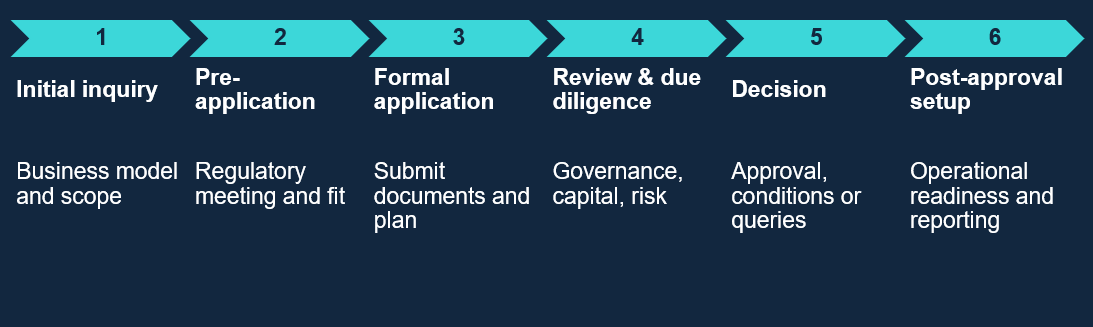
- The intention is to authorise new UK captives quickly, targeting a decision within four to six weeks for a complete application, unless the captive is particularly complex. Pre-engagement with the Prudential Regulation Authority (PRA) is encouraged.
On Tuesday, 14 July 2026, the Bank of England issued CP11/26 – A tailored regime for captive insurance,1 outlining the PRA’s proposed rules and policy settings for a new UK captive insurance regime commencing in mid-2027. Consultation on this paper will close on 14 October 2026.
This consultation paper follows a period of engagement with the industry. In July 2025, the intention to establish a UK captive regime was affirmed in the Chancellor of the Exchequer’s Mansion House speech.2 This was supported by HM Treasury’s publication of its captive insurance consultation response,3 providing early insight into the key areas under consideration by regulators in the design of the framework. A series of subject expert groups were convened from September to November 2025,4 which opined on several topics, including oversight and reporting, capital and innovation.
A new supervisory statement will be issued to deliver the new regime, along with modifications to the existing PRA rulebook to accommodate.
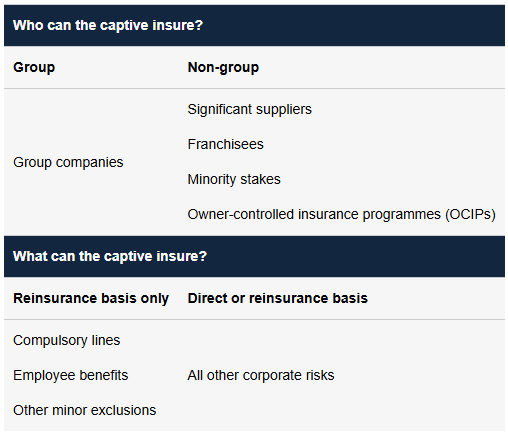
Who and what can be insured by a UK captive under the proposals?
CP11/26 clarifies the scope of the new captive regime, which will initially permit single-parent captives only. UK captives will be permitted to write both direct and reinsurance business.
The proposed regime distinguishes between exposures within the same corporate ‘group’ and those outside the group, with restrictions on insurances for non-group entities. Captive policies are permitted to cover material exposure directly from contractual arrangements on non-group undertakings, which are specific to four structures: owner-controlled insurance programmes (OCIPs), significant suppliers, franchisees and minority stakes (where the group’s stake is at least 5%). Apart from OCIPs, all material non-group undertakings are limited to 10% of a UK captive’s overall business volume, based on the lower of net written premium or net insurance liabilities for any one financial year, but temporary exceptions may be considered by the PRA. Non-group undertakings with a turnover of under £1 million are permitted on a reinsurance basis only.
The lines of business a UK captive can write will also be limited. Employee benefits will be limited to reinsurance only and will not be permitted for exposures to material non-group undertakings. Similarly, other general insurance lines (e.g., certain D&O policies where named individuals are beneficiaries) are also to be written on a reinsurance basis only.
The captive regime excludes life insurance policies, pensions (which are not considered as employee benefits) and insurances for investment risk protection. Prohibitions also apply on covering regulatory fines.
Figure 1: UK captives regime – scope overview
Source: Bank of England. (14 July 2026). CP11/26 – A tailored regime for captive insurance. Retrieved 17 July 2026 from https://www.bankofengland.co.uk/prudential-regulation/publication/2026/july/a-tailored-regime-for-captive-insurance-consultation-paper.
What are the capital and structural requirements for the new captive regime?
Flexibility is being afforded in respect of capital requirements, with a new regime distinct from Solvency UK. The proposed CCR is the higher of 10% of net insurance liabilities or 10% of net premium, subject to a minimum of £100,000. The floor of £100,000 must be met by Tier 1 capital (such as common stock), and the capital requirement in excess of this can be met with Tier 1 or Tier 2 capital (such as letters of credit and other contingent capital such as intercompany loans).
Only single-parent UK captives are permitted initially. They are expected to be structured as companies limited by shares and would not permit companies limited by guarantee (such as mutuals). Captives would be subject to the Financial Services Compensation Scheme (FSCS) and the ‘base cost’ part of the FSCS levy5 but may apply for exemption from other components.6
What are the governance and reporting requirements?
The proposed new regime is relatively light touch, requiring only two formal governance roles: a SMF1 (chief executive officer under the UK’s Senior Managers and Certification Regime) and a NED to sit on the captive’s board. There is flexibility around the need to appoint an iNED and an SMF3 (executive director) based on the nature and complexity of the captive.
Quantitative reporting is proposed to be on an annual basis and aligned to financial statutory reporting, such as financial statements prepared under UK GAAP or International Financial Reporting Standards (IFRS), which are subject to annual audit.
How long will it take for authorisation under the new UK captive regime?
Authorisation processes target a decision within four to six weeks following the submission of a complete application, which places it broadly in line with comparable regimes in Guernsey (approximately four weeks for single-parent captives)7 and the Isle of Man (approximately two to three months).8
Pre-application engagement with the PRA and the Financial Conduct Authority (FCA) is also encouraged to strengthen and streamline the application process.
Figure 2: High-level UK captive authorisations process flow
Source: Bank of England. (14 July 2026). CP11/26 – A tailored regime for captive insurance. Retrieved 17 July 2026 from https://www.bankofengland.co.uk/prudential-regulation/publication/2026/july/a-tailored-regime-for-captive-insurance-consultation-paper.
The consultation notes that the regime will focus on strong entry standards rather than extensive post-authorisation oversight.
Discussion: The onshoring opportunity (and challenge)
While details of the captive regime remain to be finalised following the consultation, ‘bringing captives home’ to the UK, as discussed by the PRA’s Shoib Khan at the June 2026 Association of Insurance and Risk Managers in Industry and Commerce (Airmic) Annual Conference,9 will not be without challenge.
Companies considering repatriation of existing captives set up elsewhere will be weighing the potential of the new regime against more-established incumbent offerings and considering the costs/benefit of change. Assuming the target lines of business are admissible under the UK regime, organisations would need to consider the frictional cost of redomiciling, including the potential loss of institutional knowledge from existing service providers (although potentially replaced with new perspectives and approaches from others). With captives typically being a longer-term, strategic consideration, it appears unlikely that these decisions would be rushed for a short-term gain, particularly for organisations harbouring more-complex business-critical exposures within their captive.
Guernsey appears to be the primary competitor domicile to the new UK regime; Guernsey, alongside Luxembourg, is one of the largest established domiciles in Europe, home to 196 captives (plus 126 cell captives) at the end of 2025.10 In 2024, it was estimated that 40% of FTSE100 companies held a captive in Guernsey,11 making it an obvious target for the UK regime’s onshoring ambitions.
Guernsey already offers many of the advantages of a UK regime, including a shared time zone, proximity to London’s insurance market and a competitive market of insurance service providers.
It also has additional strengths, including a low tax environment, a proportionate capital setting regime and strong reputation for innovation in securitisation (e.g., use of insurance-linked securities) and structuring (e.g., incorporated cell and protective cell companies).12 By contrast, the use of protected cell companies in the UK will require further legislative change, expected only after 2027,13 and tax incentives have effectively been ruled out as an area for regime competitiveness.
Further, the track record for an incumbent regulator, such as the Guernsey Financial Services Commission (GFSC), gives participants greater clarity around the regulatory approach and expectations. Some commentators note the regulatory culture, including the ability to engage directly with regulators and their existing knowledge of market participants, as a unique selling point, emphasising the value of these factors beyond the specific rules of the domicile.14
Figure 3: Competitive advantages of the Guernsey regime
| Competitive advantages of the Guernsey regime |
|---|
|
Despite this, some organisations may still prefer an onshore solution. A UK captive could offer a UK-based organisation greater alignment across operational, governance, tax, regulatory and legal matters. This innate advantage was reflected in a 2026 Airmic Captives Survey,15 which had 59% of responding members (of which over 60% were Guernsey domiciled) interested in forming a new captive or moving a captive to the UK, provided the captive regime is ‘proportionate.’ This is far from a guaranteed success for the UK but shows general openness if the regulatory settings are right.
Undoubtedly there will be competition between domiciles to attract captives and the economic benefit they bring. However, rather than seeing it as a zero-sum game, industry bodies such as Airmic and the Guernsey International Insurance Association (GIIA) have responded positively to the introduction of the UK captive regime,16 recognising the potential for the regime to further establish the profile of captives as a mainstream risk management vehicle and increase interest in the area more broadly.
Given the strategic nature of captive insurance, the success of the subsequent UK captive regime will not be measured overnight, but over a longer-term horizon. This consultation comes as the first real test of the reception to a UK captive regime—and whether it is considered genuinely competitive with established domiciles and convincing in its intended regulatory approach.
1 Bank of England. (14 July 2026). CP11/26 – A tailored regime for captive insurance. Retrieved 17 July 2026 from https://www.bankofengland.co.uk/prudential-regulation/publication/2026/july/a-tailored-regime-for-captive-insurance-consultation-paper.
2 Reeves, R. (15 July 2025). Mansion House 2025 speech [Speech transcript]. Gov.uk. Retrieved 17 July 2026 from https://www.gov.uk/government/speeches/rachel-reeves-mansion-house-2025-speech.
3 HM Treasury. (July 2025). Captive insurance – consultation response. Retrieved 17 July 2026 from https://assets.publishing.service.gov.uk/media/686fc3f910d550c668de3e04/Captive_insurance_Consultation_Response.pdf.
4 Bank of England. (15 July 2025). Joint statement by the PRA and FCA on HM Treasury’s captive insurance consultation response. Retrieved 17 July 2026 from https://www.bankofengland.co.uk/prudential-regulation/publication/2025/july/captive-insurance-statement.
5 CP11/26 para. 3.57: ‘As FSCS participants, UK captives would be required to pay the “base costs” part of the FSCS levy, which would be a small annual amount based on the periodic fees payable to the PRA and the FCA (as proposed in their separate CPs).’
6 CP11/26 para. 3.58: ‘The PRA considers that UK captives would generally be exempt from paying the “compensation costs” and “specific costs” parts of the FSCS levy for the reasons set out above. To qualify for an exemption, UK captives would need to confirm in writing with FSCS Limited that they do not conduct business that could give rise to a protected claim by an eligible claimant and have no reasonable likelihood of doing so.’
7 Harrison, L. (13 July 2023). Guernsey makes strong start to 2023 captive activity. Captive Intelligence. Retrieved 17 July 2026 from https://captiveintelligence.io/guernsey-makes-strong-start-to-2023-captive-activity/.
8 Isle of Man Captive Association. (n.d.). Captive FAQ. Retrieved 17 July 2026 from https://www.captive.im/captive-faq/.
9 Khan, S. (16 June 2026). It’s coming home [Speech transcript]. Bank of England. Retrieved 17 July 2026 from https://www.bankofengland.co.uk/speech/2026/june/shoib-khan-speech-at-the-airmic-annual-conference-2026.
10 Guernsey Financial Services Commission. (n.d.). Statistics. Retrieved 17 July 2026 from https://www.gfsc.gg/industry-sectors/insurance/statistics.
11 Captive International. (26 January 2024). Guernsey captives may save UK blue chips £100m a year. Retrieved 17 July 2026 from https://www.captiveinternational.com/guernsey-captives-may-save-uk-blue-chips-pound-100m-a-year.
12 Guernsey Finance. (27 August 2019). Reinsurance and ILS. Retrieved 17 July 2026 from https://www.guernseyfinance.com/industry-resources/literature/insurance/reinsurance-and-ils/.
13 Richardson, M. (29 April 2026). UK government plans captive PCC legislation post-2027 regime launch. Captive Review. Retrieved 17 July 2026 from https://captivereview.com/news/uk-government-plans-captive-pcc-legislation-post-2027-regime-launch/.
14 Richardson, M. (17 June 2026). UK captive regime closer to reality as focus shifts to PRA. Captive Review. Retrieved 17 July 2026 from https://captivereview.com/news/uk-captive-regime-closer-to-reality-as-focus-shifts-to-pra/.
15 Association of Insurance and Risk Managers in Industry and Commerce. (4 March 2026). Captives: A resilient strategy for the future – the 2026 captives survey of Airmic members. Retrieved 17 July 2026 from https://www.airmic.com/system/files/technical-documents/airmic-captives-survey-report-2026-v1.pdf.
16 Guernsey Finance. (24 July 2025). Guernsey International Insurance Association welcomes HM Treasury’s response to the UK captive regime consultation. Retrieved 17 July 2026 from https://www.guernseyfinance.com/industry-resources/news/2025/guernsey-international-insurance-association-welcomes-hm-treasury-s-response-to-the-uk-captive-regime-consultation/.