Selected drugs for the third cycle of Medicare Drug Price Negotiation
The Inflation Reduction Act of 2022 (IRA) established the Medicare Drug Price Negotiation Program (MDPNP), empowering the Centers for Medicare and Medicaid Services (CMS) to negotiate prices for the highest-expenditure drugs covered under Medicare Parts B and D that meet all inclusion criteria.1 Initial Price Applicability Year (IPAY) 2028 represents the third cycle of drug selections, expanding the MDPNP to include 15 additional products following the 10 drugs selected for IPAY 2026 and 15 drugs for IPAY 2027. The IPAY 2028 selection marks the first cycle where Part B drugs are eligible for inclusion.
Figure 1 summarizes the share of total gross 2024 Medicare costs of selected drugs grouped by IPAY and the therapeutic class.
Figure 1: Medicare gross costs under negotiation by therapeutic class and year
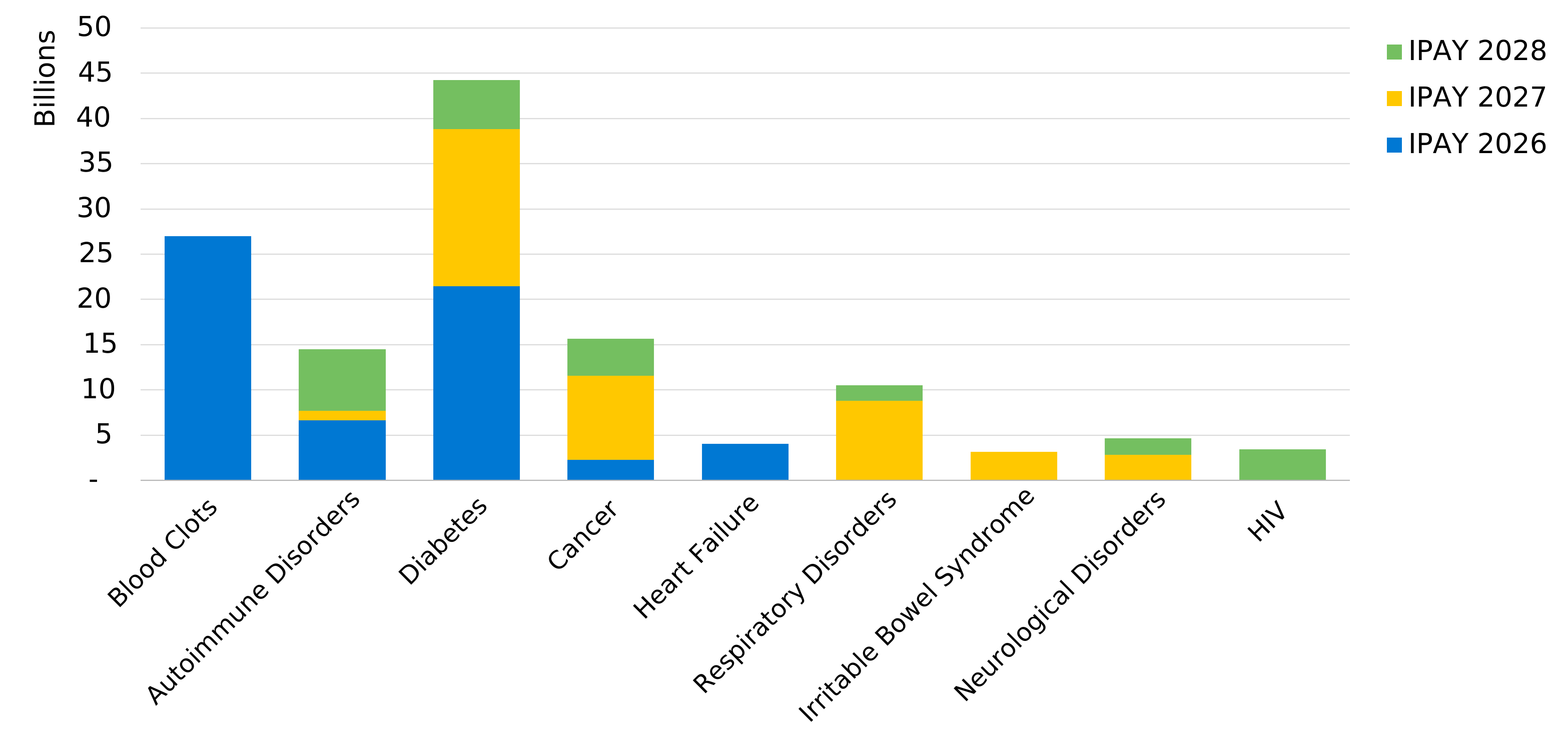
Based on CY2024 total market spend summarized from CMS’s 100% Research Identifiable Files. MA spending is estimated using CY2023 data projected to 2024 and assumes average charge by drug is equivalent to FFS claim costs.
IPAY 2028 Selected Drugs
Among the IPAY 2028 selected products are five drugs that treat autoimmune disorders, making up a third of the new selections. As of February 2026, several of these drugs have limited formulary coverage, with no standalone Part D plans (PDPs) covering Orencia or Cimzia, and Entyvio is covered for only 3% of PDP lives. Despite this limited Part D coverage, nearly 30% of Medicare spending on these products falls under the Part D benefit. Negotiated maximum fair prices (MFPs) will lower the prices for each of these drugs but will also significantly expand formulary coverage.
Six drugs are added in protected classes: four in oncology, one antipsychotic, and one antiretroviral. Negotiated MFPs for these drugs are expected to yield higher total program savings, as there are generally lower rebate levels within protected classes today.
To be selected, a drug must not have generic or biosimilar competition; once that competition exists, the reference drug will be removed from the next selected drug list.2 Two IPAY 2028 selections, Xeljanz and Xolair, are expected to face generic and biosimilar competition, respectively, this year. MFPs may never take effect or be announced for these drugs if CMS determines bona fide marketing is occurring for their approved generics/biosimilars before the negotiation period concludes in November 2026. A third selected drug, Trulicity, is expected to face biosimilar competition in 2027, which could result in this drug being removed from the selected drug list after just one year.
Alongside the 15 new selections, this is the first time prior selections were also eligible for renegotiation, resulting in Tradjenta undergoing renegotiation. During 2027, Tradjenta will exceed 16 years of exclusivity and be reclassified as a long monopoly. This meets one of CMS’s criteria for renegotiation, bringing Tradjenta’s manufacturer, Boehringer Ingelheim, back to the table for a 2028 reset of its MFP. However, Tradjenta generics are expected later this year, which would result in Tradjenta’s removal from the selected drug list for 2028, making renegotiation a moot point.
Evolution of the Medicare Drug Price Negotiation selection process
IPAY 2028 is a pivotal year for the program, as it marks the first time both Medicare Part D and Part B drugs are included for selection. Industry expectations for Part B drug selections have shifted multiple times as new regulatory and legislative information emerged.
Medicare Advantage data
The IRA legislative text was unclear on whether Part B drugs would be ranked for selection using only Medicare Fee-for-Service (FFS) claim spending or a combination of FFS and Medicare Advantage (MA) data. This ambiguity created uncertainty as to how spending for Part B drugs would be quantified for the selection ranking. MA plans submit encounter data to CMS, but these submissions do not include actual paid amounts, making the data challenging to use for ranking total expenditures.
However, excluding MA data would have inherently skewed selections toward Part D drugs, which include data from both MA and standalone PDPs. Given that more than half of Medicare beneficiaries are enrolled in MA plans, this exclusion would have created a substantial gap in the expenditure picture.
CMS resolved this uncertainty in the final IPAY 2028 guidance by confirming that MA data would be included and outlining a methodology for estimating MA expenditures.3 This decision had direct selection implications. For instance, Botox—which has the highest proportion of MA expenditures among the IPAY 2028 drugs—likely would not have been selected without MA data inclusion.
Orphan drug exclusions
Another factor reshaping the IPAY 2028 selection landscape was the passage of H.R.1 (commonly known as the “One Big Beautiful Bill”) in July 2025. H.R.1 modified the IRA's orphan drug exclusion by effectively resetting the selection timeline. Under H.R.1, the eligibility clock now begins in the year a drug is first approved for a non-orphan condition, rather than its initial market entry.
This change affects products initially approved for rare diseases but later expanded to broader, non-orphan indications. The legislation essentially provides additional years of protection from price negotiations for these drugs.
The impact of H.R. 1’s orphan drug exclusion on IPAY 2028 selections was substantial. Keytruda and Opdivo—two of Medicare's highest-expenditure drugs—would almost certainly have been selected for IPAY 2028 in the absence of H.R.1. Both products originally received orphan designations for specific cancer types before expanding to more common indications. The total spending in the selection period for the 15 selected IPAY 2028 drugs encompasses nearly $27 billion in gross drug costs. Prior to the H.R. 1 changes to orphan drug exclusions, however, we estimate the 15 selected drugs (including Keytruda and Opdivo) would have comprised approximately $39 billion (44% more).
Part B vs. Part D
Figure 2 shows the split of expenditures between Part B and Part D for IPAY 2028 drugs.
Figure 2: Proportion of 2024 Part B vs. Part D spending for IPAY 2028 selected drugs
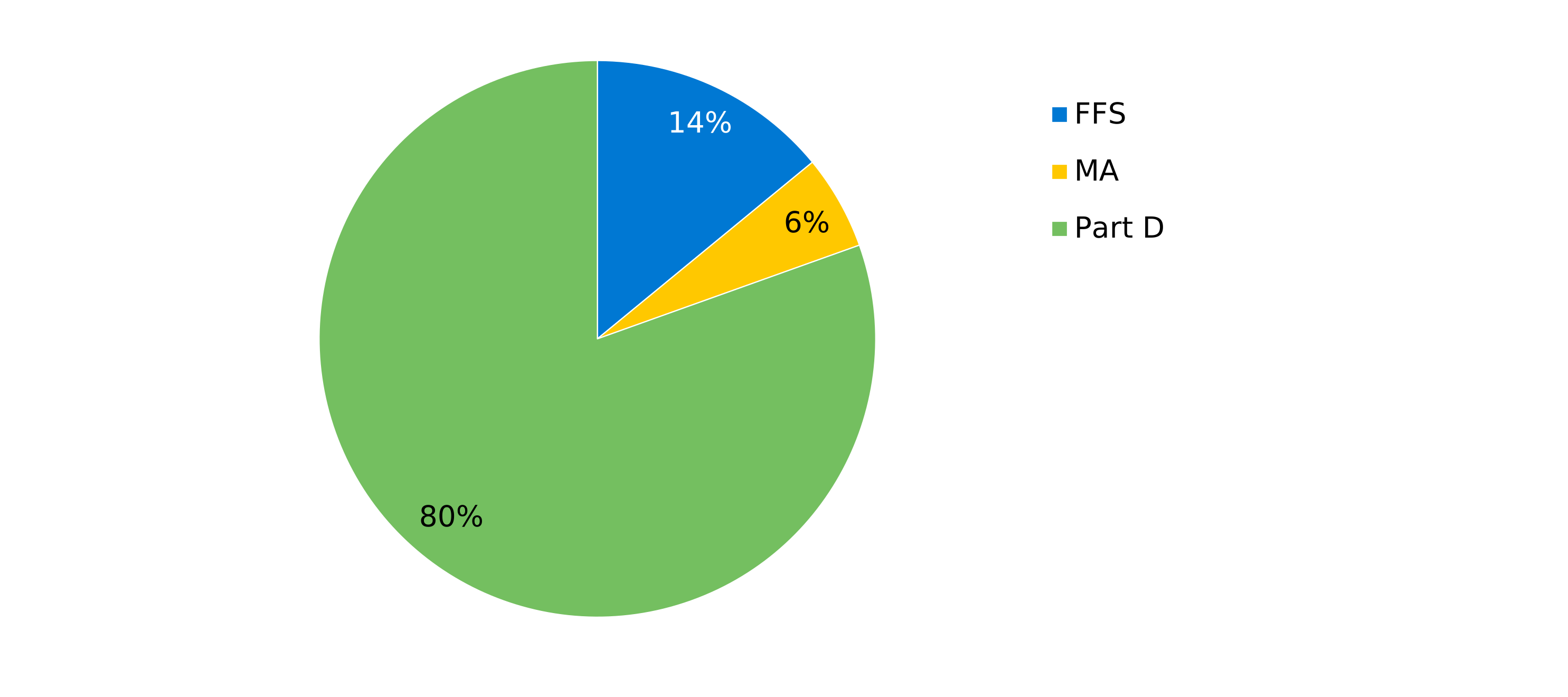
Based on CY2024 total market spend summarized from CMS’s 100% Research Identifiable Files. MA spending is estimated using CY2023 data projected to 2024 and assumes average charge by drug is equivalent to FFS claim costs.
As seen in Figure 2, 80% of spending for the newly selected drugs is in the Part D benefit, despite this being the first year of Part B selections. Even the products most commonly provided under the Part B benefit also have a meaningful share of Part D claims (10% to 40%), contributing to the heavy weight on Part D.
Downstream implications of selection on physician administered drugs
Five of the 15 selected products for IPAY 2028—Orencia, Entyvio, Xolair, Botox, and Cimzia—have the majority of their gross spending under the Part B benefit. Cosentyx also has notable Part B spending, but the vast majority is in the Part D benefit.
Although numerous questions relate to how the MFP for physician-administered claims will be effectuated, there are several important dynamics critical to highlight:
Effectuation of MFP will directly change provider reimbursement. Under Medicare Part B, separately payable physician-administered drugs receive a 6%4 add-on reimbursement of the average sales price (ASP), which is intended to cover overhead costs associated with acquiring, storing, and administering the drug. For selected drugs, the add-on payment calculation will shift to 6% of the MFP amount, substantially lowering the add-on payment for those drugs. This transition may cause financial stress to physician practices, infusion centers, and other organizations, where these five products comprise a material portion of their physician administered drug reimbursement. Figure 3 illustrates the potential reduction in add-on payments for a theoretical selected drug.
Figure 3: Add-on payment change due to MFP effectuation
| Medicare Part B Reimbursement Illustration $1,000 ASP and $400 MFP |
||||
|---|---|---|---|---|
| Quarter | Basis | Drug Cost | Add-on Payment | Total Reimbursement |
| Q4 2027 | ASP + 6% | $1,000 | $60 | $1,060 |
| Q1 2028 | MFP + 6% | $400 | $24 | $424 |
| Change | ($600) | ($36) | ($636) | |
MFP will impact ASP and require reevaluation of non-Medicare market contracts. Utilization at the MFP will factor into the calculation of ASP.5 CMS incorporates sales data on a two-quarter lag in order to calculate ASP. As a result, ASP-based reimbursement agreements would show a decline in add-on payment amounts in the third quarter following MFP effectuation. Figure 4 builds on the example in Figure 3 to demonstrate the timing and potential magnitude of ASP erosion in the commercial market, assuming reimbursement at 150% of ASP.
Figure 4: ASP reduction resulting from MFP effectuation
| Reimbursement Illustration Commercial Reimbursement ASP + 50% $1,000 ASP and $400 MFP 50% Medicare Mix |
||||||||
|---|---|---|---|---|---|---|---|---|
| Quarter | ASP | MFP | Medicare Rx |
Medicare Add-on |
Medicare Total |
Commercial Rx |
Commercial Add-on |
Commercial Total |
| Q4 2027 | $1,000 | NA | $1,000 | $60 | $1,060 | $1,000 | $500 | $1,500 |
| Q1 2028 | $1,000 | $400 | $400 | $24 | $424 | $1,000 | $500 | $1,500 |
| Q2 2028 | $1,000 | $400 | $400 | $24 | $424 | $1,000 | $500 | $1,500 |
| Q3 2028 | $700 | $400 | $400 | $24 | $424 | $700 | $350 | $1,050 |
| Q4 2028 | $700 | $400 | $400 | $24 | $424 | $700 | $350 | $1,050 |
This illustrates the potential for a material shortfall in commercial market reimbursement due to MFP effectuation for Part B drugs. Continuing to anchor on ASP for commercial market reimbursement may result in significant uncertainty, especially in the third quarter following effectuation. As such, contract carveouts or alternative agreements that do not rely on ASP are options to ensure equitable payments relative to prior prices. These contracts should be evaluated in advance to assist all stakeholders in the transition during MFP effectuation.
The interaction between MFP and the Medicaid Drug Rebate Program may lead to greater manufacturer concessions. Although express provisions in the IRA and guidance forbid the duplication of MFP and 340B concessions on the same claim, there are no similar provisions for the non-duplication of MFP and Medicaid Drug Rebate Program (MDRP) rebates.1 Typically, when a dual-eligible beneficiary has a Part B claim, Medicare is the primary payer and covers 80% of the gross costs (typically ASP + 6%). For dual-eligible beneficiaries, the remaining 20% of the gross costs is paid by Medicaid on behalf of the member, which results in the claim being eligible for MDRP rebates. Figure 5 illustrates the potential impact of this dynamic depending on whether the MFP sets a new Best Price.
Figure 5: Duplication of manufacturer concessions between MFP and MDRP
| Medicare Part B FFS Claim* Dual-Eligible Patient |
|||
|---|---|---|---|
| No MFP Q128 | MFP New Best Price |
MFP No New Best Price |
|
| Average Manufacturer Price | $1,000 | $1,000 | $1,000 |
| MFP Discount | $0 | $600 | $600 |
| MDRP Payment | $400 | $600 | $400 |
| Manufacturer Net | $600 | ($200) | $0 |
*Ignores administration costs and add-on payments
Figure 5 shows that when a new Best Price is set, there is a direct reduction in manufacturer revenue due to duplication, as seen by the substantially lower Medicare payment coupled with the higher MDRP payment. Even in situations where a new Best Price is not set, the additional MFP concession on top of the existing MDRP payment may substantially reduce manufacturer revenue.
Impacts of 2028 MFPs will ripple through the pharmacy supply chain
Although there may be clarifications in future guidance regarding these more complex interactions, they serve to highlight the significant first- and second-order impacts of MFP effectuation for physician-administered drugs. The implications extend far beyond simple price reductions. As this analysis demonstrates, the effectuation of MFPs for physician-administered drugs creates a cascade of downstream effects: eroding add-on payments for providers, compressing ASP-based commercial reimbursements, and potentially duplicating manufacturer concessions through MDRP interactions. The effectuation of 2028 MFPs, particularly in Part B, will bring new operational and financial challenges to all stakeholders in the pharmacy supply chain. Proactive preparation will be critical for success.
- Pharmaceutical manufacturers: Reevaluate commercial contracting strategies that rely on ASP benchmarks. Consider alternative pricing mechanisms, carveouts for selected drugs, and proactive communication with provider and payer partners to ensure continuity of care.
- Providers and health systems: Conduct financial stress tests to assess the impact of reduced Part B reimbursement. Evaluate operational efficiencies, alternative revenue streams, and potential care delivery model adjustments before MFPs take effect in 2028.
- Plans and PBMs: Begin strategic planning for expanded formulary coverage of newly selected drugs, particularly those with limited current access. Model the interplay between MFP effectuation, member utilization changes, and total cost of care.
- Policymakers and regulators: Evaluate the real-world implementation of IPAY 2028 selections closely, particularly in the physician-administered space. Monitor for unintended consequences that impact financial stakeholders and patient access.
Organizations that engage in early scenario planning, modeling, and stress testing will be best positioned to navigate the complexities of MFP effectuation while maintaining financial sustainability.
1 The Inflation Reduction Act of 2022, Pub. L. No. 117-169, 136 Stat. 1818 (2022). https://www.congress.gov/bill/117th-congress/house-bill/5376/text.
2 The year of removal relative to the launch of a generic or biosimilar will vary depending on the point in the year the generic or biosimilar was launched.
3 Center for Medicare. (2025, September 30). Medicare drug price negotiation program: Final guidance, implementation of Sections 1191-1198 of the Social Security Act for initial price applicability year 2028 and manufacturer effectuation of the Maximum Fair Price in 2026, 2027, and 2028. Centers for Medicare & Medicaid Services. https://www.cms.gov/files/document/ipay-2028-final-guidance.pdf.
4 This add-on payment is reduced due to sequestration, effectively reducing it to 4.3%. Biosimilars currently have an 8% add-on as a percentage of their reference product’s ASP as a result of the Inflation Reduction Act of 2022.
5 Medicare and Medicaid Programs; CY 2026 payment policies under the Physician Fee Schedule and other changes to Part B payment and coverage policies; Medicare Shared Savings Program requirements; and Medicare Prescription Drug Inflation Rebate Program, 90 Fed. Reg. 32,352 (proposed July 16, 2025). https://www.federalregister.gov/documents/2025/07/16/2025-13271/medicare-and-medicaid-programs-cy-2026-payment-policies-under-the-physician-fee-schedule-and-other.